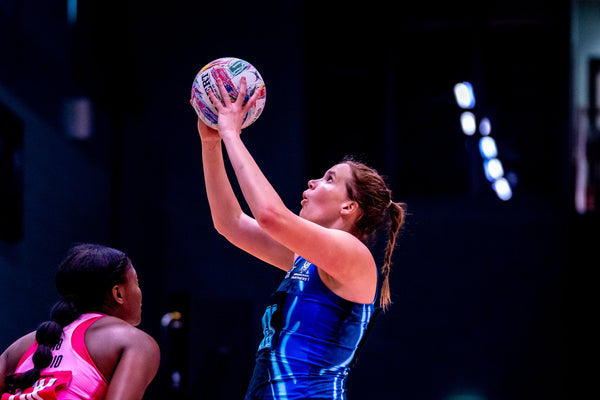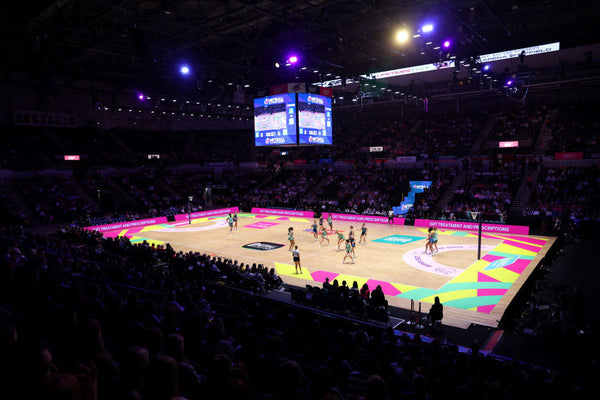








If you were to look solely at the statistics from the London Pulse vs Manchester Thunder Major Semi-Final, you might assume that London Pulse were the dominant defensive side. Pulse recorded 15 deflections to Thunder’s 11, 12 gains to Thunder’s 10, and 6 intercepts compared to Thunder’s 5. In fact, the only defensive statistic that Thunder outperformed Pulse in was defensive rebounds. So, with many of the key defensive metrics favouring Pulse, how did Manchester Thunder control the game and secure their place in the Grand Final?
The answer lies in their defensive strategy. Thunder played a game built on restriction. Their objective was not necessarily to create spectacular turnover, but to limit forward options, increase the number of phases Pulse needed to reach goal, and apply relentless one-on-one defensive pressure throughout the full 60 minutes.Their discipline and commitment to the game plan prevented Pulse from finding rhythm in attack and highlighted an important lesson for coaches: effective defence is not always about the number of gains you record. Sometimes, it is about consistently making the opposition work harder for every possession.
Centre Pass Defence Strategy
One of the most impressive aspects of Thunder’s performance was the clarity of their centre pass defence. When reviewing the game, it becomes clear that Thunder were incredibly deliberate in their set-up. Rather than gambling for immediate turnovers, their focus was on disrupting Pulse's attacking flow, increasing the number of phases required to reach the circle, and forcing attacking errors through sustained pressure.
A key feature of this strategy was their ability to deny the second phase of the centre pass. On multiple occasions, Thunder created a three-versus-one scenario around the receiving players, effectively shutting down WA Maseko's ability to access the backspace and receive the second pass. This forced Pulse away from their preferred attacking patterns and reduced their ability to gain early court depth.Tactically, Thunder also encouraged GA Kelly to become the primary receiver from centre pass. While this may appear harmless, it had a significant impact on Pulse's attacking structure.
With the WA removed as a viable second-phase option, Kelly and C Smith were required to work much harder to generate depth through the court. At the same time, GS Tchine became increasingly isolated in the goal third. This created a difficult decision for Tchine. She could either exit the circle and leave the shooting circle without a strong target, or hold position and become vulnerable to an overloaded defensive unit. Both scenarios played directly into the strengths of Huckle and McCormick. The Thunder defenders were able to challenge exits, create numerical advantages around the circle edge, and force Tchine into taking shots further away from the post than she would have preferred.
Through-Court Defensive Pressure
Thunder's through-court defensive strategy was simple but exceptionally well executed:
- Pressure early. Mark one-on-one. Limit forward options
There was nothing overly complicated about the approach, but its effectiveness came from Thunder's consistency and discipline. By committing to strong individual defensive responsibilities, Thunder reduced Pulse's available passing options and increased the likelihood of attacking errors. Rather than chasing interceptions, they focused on making every pass more difficult. Following turnovers, Thunder were particularly quick to establish strong front and open defensive positions against Pulse's attackers. This regularly forced Pulse into longer, riskier passes that suited Thunder's athletic defensive line.
Players such as Carter and McKevitt were able to challenge these aerial balls effectively, creating moments of disruption even when they did not necessarily win direct possession. As the game progressed, the sustained defensive pressure began to influence Pulse's attacking movement. With forward options continually denied, attackers increasingly retreated for the ball and struggled to generate the dynamic movement required to progress through court.
Perhaps most importantly, Thunder maintained impressive discipline around contact penalties. By avoiding unnecessary infringements, they denied Pulse the opportunity to reset and relieve pressure through repeated penalties. This ensured that the one-on-one defensive pressure remained constant throughout the match. For coaches, this provides a valuable reminder that defensive success is often built on cumulative pressure rather than highlight-reel turnovers.
Circle Defence Connections
While Thunder's team defence laid the foundation, the connection between McCormick and Huckle in the circle ultimately helped swing momentum in Thunder's favour. The pressure applied through court consistently delayed and disrupted feeds into the circle, allowing Huckle to establish strong defensive positioning against Tchine. Because Pulse were frequently forced away from the circle edge and denied early entry opportunities through Kelly, Huckle was able to get around the body of the shooter and challenge the front ball repeatedly throughout the game.
At the same time, Thunder's centre pass strategy often forced Kelly higher up the court, creating opportunities for McCormick to drop into the circle earlier and provide support. The partnership between the two defenders was excellent. Together, they restricted Tchine's movement, removed easy feeding options, and forced Pulse attackers to play around the circle edge rather than directly into the shooting circle. This additional ball movement increased opportunities for interceptions and further slowed Pulse's attacking momentum.
The early work from McKevitt and Carter was also critical. By denying depth on the second phase and forcing the GS to work out of the circle, they created situations where Huckle and McCormick could dictate movement and deny access to the one-point zone. As a result, Tchine was often forced into less comfortable shooting positions, which contributed to Thunder's dominance on the defensive rebound statistic—the one defensive category in which they clearly outperformed Pulse.
Coaching Takeaways
While Pulse's defence remains one of the most highly regarded units in the league, this semi-final demonstrated the power of a cohesive team defensive strategy. Thunder's success was not built on extraordinary individual defensive statistics. Instead, it came from seven players committing fully to a shared game plan and executing it consistently for 60 minutes.
Their defensive objectives were clear:
- Limit forward options.
- Deny the second phase of centre pass.
- Increase the number of phases required to reach goal.
By sticking to these principles, Thunder were able to place Pulse under sustained pressure from the opening whistle until the final seconds.For coaches, this game serves as an excellent example of how effective defence does not always need to be complex. Often, the most successful defensive performances are built on clarity, discipline, collective effort, and the confidence to trust a game plan for the full duration of a match.
[carousel]